


BIX ARTICLE
Zero Coupon Bond
May 11, 2026
|
6 min read
Featured Posts
Social Bonds Illustrative Use-Of-Proceeds Case Studies Coronavirus
Jul 06, 2020
|
2 min read
Sustainable Banking Network (SBN) Creating Green Bond Markets
Jul 06, 2020
|
2 min read
Why is Inflation Making a Big Comeback After Being Absent for Decades in the U.S.?
Mar 24, 2022
|
7 min read
SC issues Corporate Governance Strategic Priorities 2021-2023
Mar 29, 2022
|
3 min read
In the diverse world of fixed-income securities, the zero-coupon bond offers a unique proposition for investors. Unlike traditional bonds that pay periodic interest, zero-coupon bonds are purchased at a discount to their face value and pay the full face amount at maturity. The return to the investor is the difference between the purchase price and the par value.
For investors in Malaysia, Bond and Sukuk Information Exchange (BIX Malaysia) serves as the premier centralized platform to research, analyse, and track these instruments. By integrating theoretical foundations with market-specific context, this paper provides a structured understanding of how zero-coupon instruments function and their application in portfolio construction.
What is a Zero-Coupon Bond?
In the fixed-income market, a "coupon" refers to the periodic interest payment made to bondholders. As the name implies, a zero-coupon bond does not make these regular interest payments.
Zero-coupon bonds are a core instrument within fixed-income markets and play a critical role in the construction of the term structure of interest rates. Unlike conventional coupon-bearing bonds, zero-coupon bonds do not provide periodic interest payments; instead, they are issued at a discount and redeemed at par upon maturity.
Instead, investors generate returns through capital appreciation. The bond is issued at a discount to its nominal value (e.g., issued at RM 980 with a face value of RM 1,000). The investor holds the bond until maturity and receives the full par value. The RM 20 difference represents the return on investment.
In Malaysia, such instruments are commonly observed in the form of Treasury bills, Islamic discount instruments, and certain medium-term notes issued without coupons. Bond and Sukuk Information Exchange (BIX Malaysia) provides centralised data on bond and sukuk issuances, supporting transparency and market access.
Valuation of Zero-Coupon Bonds
The price of a zero-coupon bond is the present value of its face value discounted at the required yield to maturity (YTM), assuming annual compounding :
Price = FV / (1 + r)^n
Where P = price, FV = face value, r = yield, and n = maturity.
If you want a 5% annual yield on a 20-year zero with a RM10,000 face value:
Face Value = RM10,000
Yield = 5%
Maturity = 20 years
Price = RM10,000 / (1.05)^20 = RM10,000 / 2.6533 = RM3,768.60
You pay RM3,768.60 today. Over 20 years, the bond accretes its theoretical value rises each year until it reaches RM10,000. The accretion follows a compounding curve, not a straight line. In year one, the bond might accrete only RM188 of value. In year 19, it accretes nearly RM476. This exponential growth is the magic of compounding working silently inside the bond.
Advantages and Risks
Before searching for these bonds on the BIX mobile app or website, consider the following factors highlighted by the platform's educational resources:
| Feature | Zero-Coupon Bond (Discounted) | Traditional Bond (Coupon) |
|---|---|---|
| Income Stream | No cash flow until maturity | Regular semi-annual/ annual income |
| Purchase Price | Deep discount (e.g., 95% of value) | Near par value (e.g., 100% of value) |
| Interest Rate Sensitivity |
High (Duration equals maturity) | Lower (Duration is less than maturity) |
| Reinvestment Risk | None (No coupons to reinvest) | Yes (Uncertainty on reinvesting coupons) |
Pros:
- No Reinvestment Risk: You don't have to worry about finding a good rate to reinvest interest payments, as there are none until the bond matures.
- Predictability: If held to maturity, the return is known upfront, assuming the issuer does not default.
- Interest Rate Risk: Zero-coupon bonds are highly sensitive to interest rate changes. If interest rates rise, the market price of a zero-coupon bond will fall more sharply than a similar coupon bond.
- Phantom Income: In some tax jurisdictions, the imputed interest (the discount accruing annually) may be taxable as income even though the investor has not received cash.
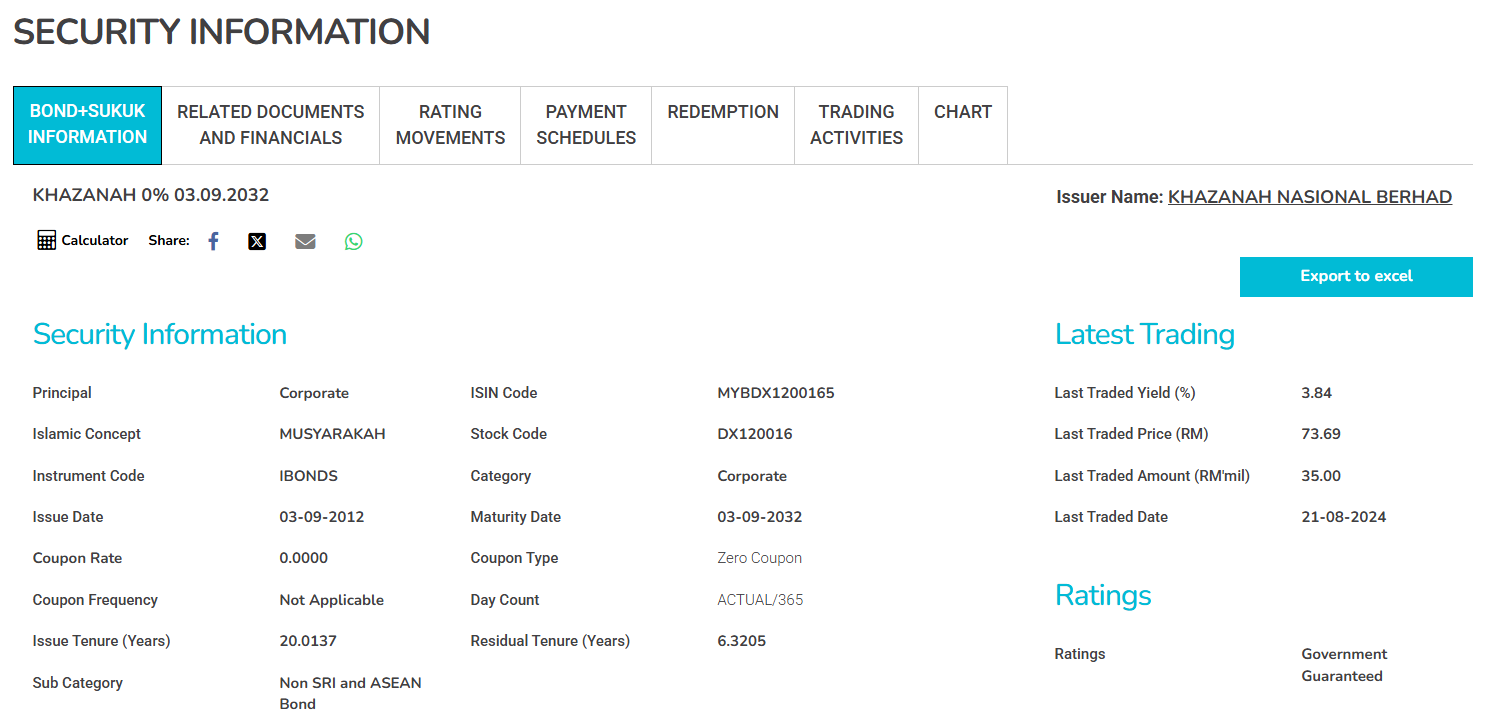
1. KHAZANAH 0% 03.09.2032
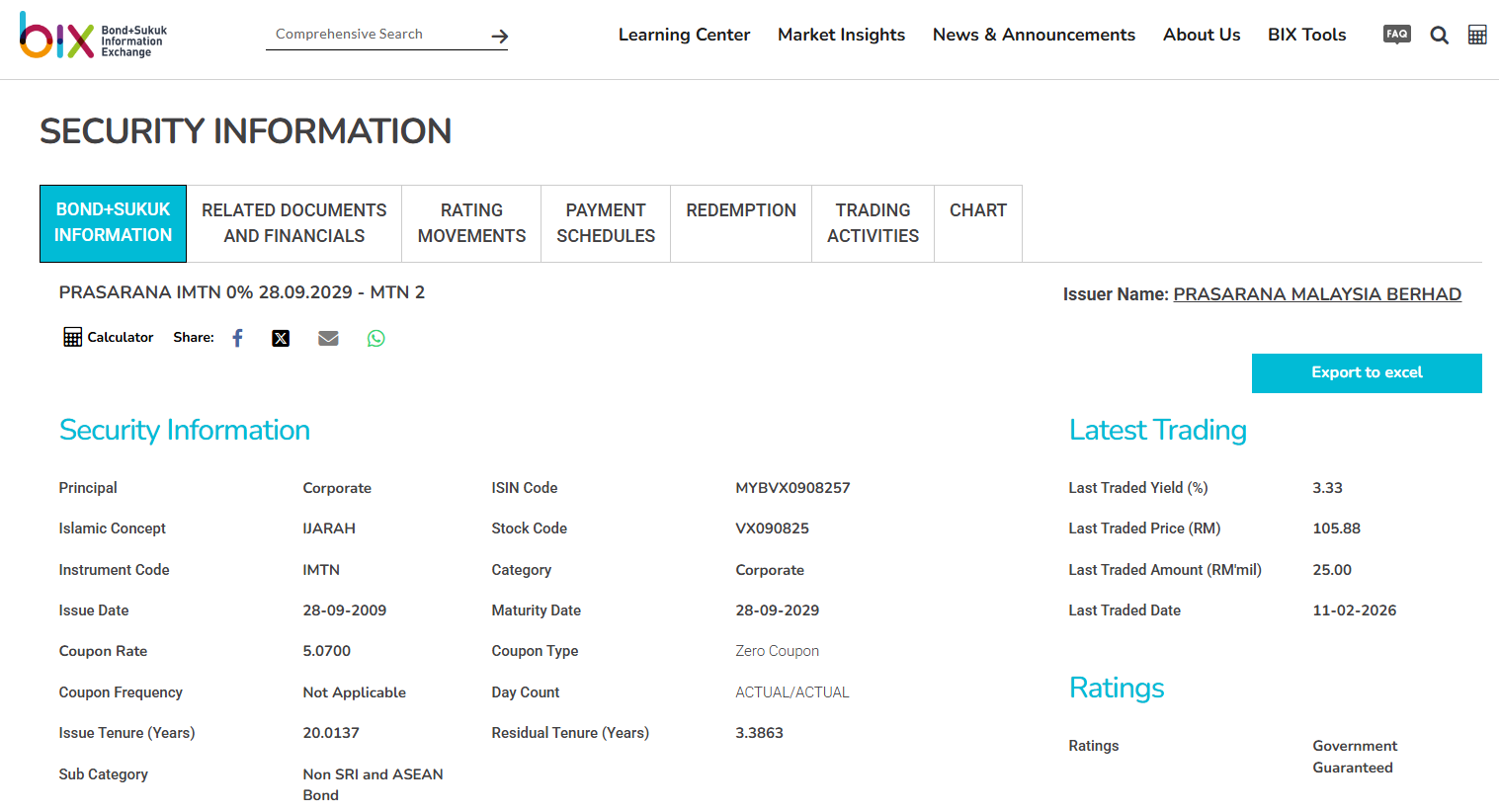
2. PRASARANA IMTN 0% 28.09.2029 - MTN 2
Conclusion
Zero-coupon bonds represent a distinctive and valuable tool within the Malaysian fixed-income landscape. By offering a clear, upfront return through a discounted purchase price rather than periodic interest payments, they eliminate reinvestment risk and provide predictable outcomes for investors who hold them to maturity.
However, the unique nature of zero-coupon bonds demands careful consideration. Their high sensitivity to interest rate fluctuations means investors must have a clear view of market direction and a holding period that aligns with the bond's duration. Additionally, credit risk remains paramount, as the entire return depends on a single lump-sum payment at maturity.
For the Malaysian investor seeking a straightforward, no-coupon-reinvestment vehicle or for those looking to match a specific future liability with a known cash flow zero-coupon bonds are worthy of a place in a diversified portfolio. As always, thorough research using BIX's comprehensive data, combined with professional financial advice, is the prudent path forward.
Disclaimer
This report has been prepared and issued by Bond and Sukuk Information Platform Sdn Bhd (“the Company”). The information provided in this report is of a general nature and has been prepared for information purposes only. It is not intended to constitute research or as advice for any investor. The information in this report is not and should not be construed or considered as an offer, recommendation or solicitation for investments. Investors are advised to make their own independent evaluation of the information contained in this report, consider their own individual investment objectives, financial situation and particular needs and should seek appropriate personalised financial advice from a qualified professional to suit individual circumstances and risk profile.
The information contained in this report is prepared from data believed to be correct and reliable at the time of issuance of this report. While every effort is made to ensure the information is up-to-date and correct, the Company does not make any guarantee, representation or warranty, express or implied, as to the adequacy, accuracy, completeness, reliability or fairness of any such information contained in this report and accordingly, neither the Company nor any of its affiliates nor its related persons shall not be liable in any manner whatsoever for any consequences (including but not limited to any direct, indirect or consequential losses, loss of profits and damages) of any reliance thereon or usage thereof.
YOU MAY ALSO LIKE

ARTICLE
Oct 22, 2026
|
10 min read
ARTICLE
Oct 09, 2026
|
16 min read
ARTICLE
Sep 24, 2026
|
9 min read
ARTICLE
Sep 07, 2026
|
8 min read