


BIX ARTICLE
Towards a modern marketplace
Mar 15, 2026
|
11 min read
Featured Posts
Social Bonds Illustrative Use-Of-Proceeds Case Studies Coronavirus
Jul 06, 2020
|
2 min read
Sustainable Banking Network (SBN) Creating Green Bond Markets
Jul 06, 2020
|
2 min read
Why is Inflation Making a Big Comeback After Being Absent for Decades in the U.S.?
Mar 24, 2022
|
7 min read
SC issues Corporate Governance Strategic Priorities 2021-2023
Mar 29, 2022
|
3 min read

The capital markets too will have a pivotal role to play in the process.
To respond to the challenges and opportunities these macro trends present, the Securities Commission (SC) has launched a transformative blueprint for the nation’s financial landscape: the Capital Market Masterplan 2026-2030 (CMP4).
The new capital market blueprint aims to help mobilise billions in private market capital for infrastructure projects to protect against climate vulnerability and electrification infrastructure driven by demand from AI data centres not just in Malaysia but the Asean region.
This plan also arrives at a critical juncture where traditional industry boundaries in the financial sector are dissolving and the nation faces significant demographic and environmental shifts.
In the current landscape, banks are offering capital market products, capital market players are engaging in lending, and a new wave of fintech firms are entering the fray with services such as digital wallets and lending platforms (peer-to-peer).
The new plan also integrates digital assets into its regulatory and asset class growth agenda.
According to SC chairman Datuk Mohammad Faiz Azmi (pic), while previous masterplans were relevant to their respective eras – focusing on the regulator’s role, governance expansion, or navigating the Covid-19 pandemic – the fourth plan represents a fundamental shift in strategy to respond to a changed world.
He added the CMP4 also plans to address the gaps in regulations as the old-school regulatory silos no longer suffice.
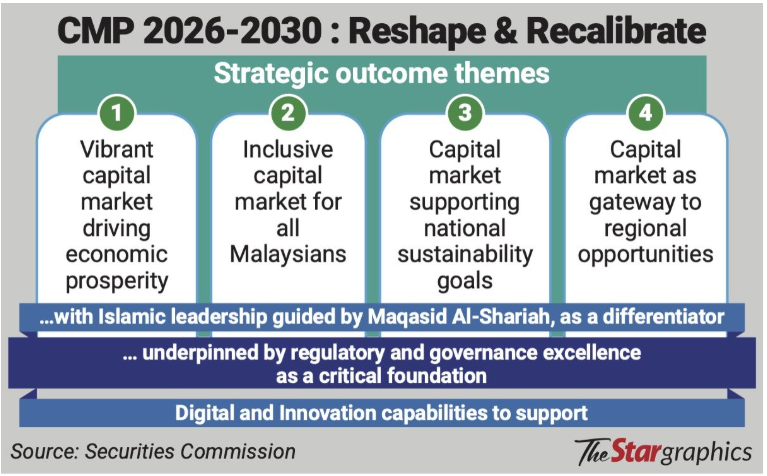
Overall, the plan serves as a roadmap for modernising the marketplace to attract stickier global investors while enhancing returns and protection for retirees and retail participants.
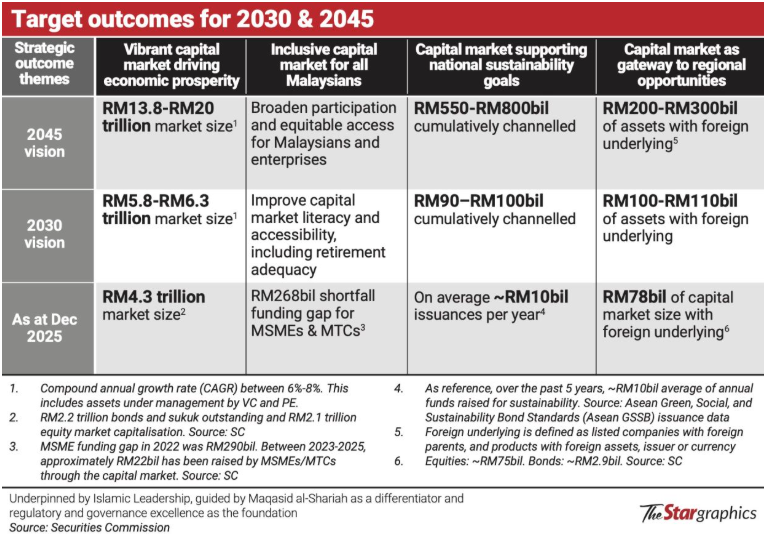
In the process, the plan hopes to grow the Malaysian capital market size from RM5.8 trillion to RM6.3 trillion by 2030 as well as raise RM90bil to RM100bil in cumulative sustainability financing and RM100bil to RM110bil of assets with foreign underlying anchored in Malaysia.
Why the plan is necessary: The driving forces
The CMP4 is anchored by four key societal and economic pillars – market vibrancy, inclusivity, sustainability and regional opportunities.
The “why” behind this ambitious plan is rooted in several pressing national challenges. The retirement crunch and demographic shift are major challenges as Malaysia is rapidly transitioning into an aged society, and the Employees Provident Fund (EPF) savings may not be sufficient for many.
Faiz says the SC has observed that while the EPF has successfully encouraged saving, retirees often have few other options for reliable income.
There is a distinct lack of annuity products that provide cash certainty rather than risky capital gains.
“The retirement challenge is an emerging and relevant issue to us. How do we ensure that cost is brought down on some of these products for higher returns? Are there other kinds of products out there that give a better return?
“And then, of course, there’s the inclusivity angle. Why is it that only rich people can buy bonds? How do I make it accessible to retail investors but in a way that doesn’t expose them to unnecessary risk?
“So, that’s the conversation around products, returns, performance. The CMP4 aims to drive the creation of products that offer consistent returns to help retirees manage the rising cost of living,” Faiz tells StarBiz 7.
The CMP4 also aims to attract fresh funds into the capital market through a multi-pronged implementation strategy involving regulatory reform, new asset classes and strategic partnerships, explains Faiz.
Among them are plans to have exchange-traded funds (ETFs) on Bursa Malaysia with exposure to regional stocks as well as syariah-compliant stocks that give investors like the EPF and international investors exposure to the Asean region.
Such measures under the CMP4 would not only diversify the investor base (investors from the Middle East, China and Central Asia) and asset classes but build on the country’s leadership in the Islamic capital market space.
This is welcomed by institutional investors like the EPF.
Its CEO Ahmad Zulqarnain Onn says the retirement fund welcomes initiatives to expand investment opportunities and deepen market activity to support long-term and offer sustainable returns for EPF members.
“Expanding the range of regional and global ETFs listed locally could provide investors with broader diversification opportunities and further deepen the domestic capital market. As a long-term institutional investor, the EPF aligns with these developments and plays its role in supporting sustainable returns,” he says.
Regulatory reforms is another component of the plan. Faiz says the transition to the “Twin Peaks” regulatory model by 2030 could be needed to meet the demands of the time.
“This approach allows regulators to be industry-agnostic, focusing on the nature of the conduct rather than whether the entity is a bank or a tech company. We need a much bigger conversation at Parliament level about why we need to move to this twin-peak model. But I think, in my view, it’s inevitable,” he says.
On the “corporate mafia” issue, Faiz acknowledges that it is a genuine problem and takes the matter seriously. This requires inter-agency coordination as these matters often go beyond securities laws.
“Such cases often reveal violations of general laws rather than just securities laws, specifically ‘criminal intimidation’ and ‘extortion’. Because the SC does not prosecute these types of crimes, the time has come to consider a formal coordinated agency task force to look into these matters holistically,” he suggests.
“Building trust requires strong institutional frameworks and processes. Like other regulators in the region, the SC has a dual mandate – developing the capital
market while regulating conduct in the capital markets. Offences under the Anti-Money Laundering Act and broader fraud or criminal laws, are led by agencies with wider enforcement powers and penalties.
“We continue to closely monitor these developments.
“Market integrity is our top priority and where appropriate, we will take necessary action within our statutory remit to protect investors.
“So, whatever we’ve been doing up to now among agencies has been done discreetly. But given recent developments, I think there is an investor trust issue that we need to address.
“When we speak about growing the size of the capital market, the importance of returns, etc, there similarly has to be a protective element in terms of preventing investors from losing money from being scammed or being subjected to massive fraud,” Faiz says.
Due to the challenges, Faiz mentions that he is drawing up a “wish list” to government, requesting additional powers to enable the SC to better deal with such issues under the masterplan.
Achieving the target: The path to RM6.3 trillion
At the end of 2025, Malaysia’s capital market amounted to RM4.3 trillion or about 2.1 times the gross domestic product (GDP)with the local equity market having a capitalisation of RM2.1 trillion and debt market (bonds and sukuk) outstanding at RM2.2 trillion, with sukuk accounting for about 64% of the amount. This exceeds the size of banking assets of RM3.8 trillion.
A central ambition of CMP4 is to grow the capital market size by between RM1.5 trillion and RM2 trillion over the next five years, reaching a total valuation of RM5.8 trillion to RM6.3 trillion
This target is not merely aspirational; it is based on a calculated mix of organic growth, corporate value enhancement and the unlocking of new asset classes.
A key initiative in the public market is the My Value Up, which aims to improve corporate performance.
The SC’s sample is the top 88 Bursa Malaysia-listed companies which account for 80% of market valuation.
“We are going to have a meeting with them in the near future to launch My Value Up. It’s about trying to get the corporates to realise that the expectation is higher on them.
“The question is, what help do they need from a policy point of view to try and achieve better outcomes? We can see there are some issues.
“We don’t as a country spend much money on research and development (R&D). In Malaysia, it’s 1% of GDP as compared to Singapore at about 3% and South Korea at 5%. There is a correlation between innovation and R&D.
“So we want to understand from these 88 companies, if we are to focus on R&D, what’s
the best way of doing this and does it make sense? Rather than it just be SC’s ideas, I want to hear from the 88,” says Faiz.
The other objective is, what can be done over the medium to long term to improve the returns. Faiz notes that sometimes, to have a vibrant market, you need to take out underperforming companies and build value through merger and acquisitions activity.
“We don’t see enough of that activity and we want to understand why. Is it because they are (companies) very comfortable? Is it because the cost of doing a merger or acquisition is too high?
“Is it because they’re very focused on the local market or
maybe the focus is outside. We don’t quite know but we want to have an ability to understand it from their point of view,” he says.
The SC also intends to monitor the companies and eventually they should be more transparent with investors as to what they’re doing in terms of their capital plans, dividend policy and what they are going to do to ensure the sustainability of their business.
“To me, as a foreign investor looking into a company in Malaysia, I would also want
to know are you sustainable? Are you going to survive the next 20 years? I think we’re probably one of the few jurisdictions emphasising value-up alongside sustainable disclosures, right now,” he explains.
The SC will also look at non-performing companies throughout the exchange to offer initiatives, but this was something Faiz did not want to announce just yet.
He adds the SC has found that many local companies in the MSCI Emerging Index (which Malaysia is only 1.2% of weightage) have not met their full weighting because of low free float. Encouraging these companies to improve free float would automatically increase the flow of funds back into the stocks and market.
Capital market growth drivers
The bond/sukuk market has maintained a compound annual growth rate of 7.5% over the last decade while the equity sector has “underperformed” at 3%-4% but the SC believes that by “pushing” the industry, it can achieve a growth rate of 6% to 8% and help achieve the RM5.4 trillion valuation by the end of the decade.
Faiz hopes the CMP4 will help bring sizeable, unlisted entities into the market to boost total valuation.
The SC has identified over 100 non-GLC companies with revenues exceeding RM2bil that remain unlisted. A prime example of a potential mega-listing that would significantly move the needle is Sarawak Energy Bhd, which the SC views as a green energy powerhouse with massive investor demand.
Additionally, the SC, Faiz says, intends to engage bumiputra-owned companies that are listable but are currently “shying away” from the market, possibly due to perceived red tape or a lack of incentives.
“CMP4’s focus on enhancing value creation among listed companies and improving financing access for MSMEs and mid-tier firms can contribute to greater market vibrancy and inclusivity, creating a stronger pipeline of quality companies that benefit institutional investors and the broader economy,” Ahmad Zulqarnain of the EPF says.
The local bond/sukuk market is expected to be a primary driver of the five-year target valuation, particularly as it takes on part of the financing burden of the National Energy Transition Roadmap (NETR) and adaptation capital expenditure.
The NETR requires an estimated RM1.2 trillion in capital over the two and a half decades, much of which banks cannot fund due to long-term risk and single-customer limits.
The local capital market could be a source for mobilising private capital for infrastructure projects to protect against climate vulnerability across the region and complement government spending.
The CMP4 also wants to bridge the funding gap, estimated at RM268bil, for small and medium enterprises and mid-tier companies by ensuring at least RM130bil is provided over five years through private credit and diversified listing options.
On digital assets, the CMP4 aims to modernise the regulatory framework by focusing on investor protection, streamlining token approvals and addressing the lack of formal redress mechanisms into its regulatory and asset class growth agenda.
Faiz says there are over 4,000 digital tokens globally, and the SC is prepared to give more leeway and allow local exchanges to determine if a token is suitable for their customers, rather than having the SC act as the primary gatekeeper for every individual token.
Industry players estimate such a move could help bring some of the RM35bil of local funds invested in global digital asset exchanges. Crypto investments in domestic exchanges are estimated at about RM25bil.
Article by BHUPINDER SINGH
Disclaimer
The information provided in this report is of a general nature and has been prepared for information purposes only. It is not intended to constitute research or as advice for any investor. The information in this report is not and should not be construed or considered as an offer, recommendation or solicitation for investments. Investors are advised to make their own independent evaluation of the information contained in this report, consider their own individual investment objectives, financial situation and particular needs and should seek appropriate personalised financial advice from a qualified professional to suit individual circumstances and risk profile. The information contained in this report is prepared from data believed to be correct and reliable at the time of issuance of this report. While every effort is made to ensure the information is up-to-date and correct, Bond and Sukuk Information Platform Sdn Bhd (“the Company”) does not make any guarantee, representation or warranty, express or implied, as to the adequacy, accuracy, completeness, reliability or fairness of any such information contained in this report and accordingly, neither the Company nor any of its affiliates nor its related persons shall not be liable in any manner whatsoever for any consequences (including but not limited to any direct, indirect or consequential losses, loss of profits and damages) of any reliance thereon or usage thereof.
YOU MAY ALSO LIKE

ARTICLE
Oct 07, 2026
|
3 min read
ARTICLE
Oct 01, 2026
|
5 min read
ARTICLE
Sep 29, 2026
|
6 min read
ARTICLE
Sep 29, 2026
|
3 min read