


BIX ARTICLE
M’sia among top emitters: Nation is third in Asean for carbon emissions per person
Jun 24, 2026
|
4 min read
Featured Posts
Social Bonds Illustrative Use-Of-Proceeds Case Studies Coronavirus
Jul 06, 2020
|
2 min read
Sustainable Banking Network (SBN) Creating Green Bond Markets
Jul 06, 2020
|
2 min read
Why is Inflation Making a Big Comeback After Being Absent for Decades in the U.S.?
Mar 24, 2022
|
7 min read
SC issues Corporate Governance Strategic Priorities 2021-2023
Mar 29, 2022
|
3 min read
In 2024, each person in the country produced 8.16 tonnes of carbon dioxide, making Malaysia the third highest emitter in Asean, after Brunei and Singapore.
Malaysia’s per-capita emissions of carbon dioxide – the greenhouse gas mainly responsible for global warming – are above the global average of 4.73 tonnes.
Our emissions also nearly doubled compared to 30 years ago, when they were 4.41 tonnes per capita in 1994, based on figures from the Global Carbon Budget (2025) and processed by the data platform, Our World in Data.
Natural Resources and Environmental Sustainability Minister Datuk Seri Arthur Joseph Kurup said the government viewed these figures seriously.
He assured that Malaysia remains committed to its target of net zero greenhouse gas emissions by 2050 and is pursuing a balanced approach that combines economic growth with emissions reduction.
The Climate Change Bill, which will be tabled in Parliament soon, may take businesses to task for offences like misreporting emissions and violating carbon market rules.
“Corporate accountability is a central pillar of the Bill.
“As the Bill is still being finalised, details relating to offences and penalties remain subject to consideration,” he said when contacted.
The Bill is currently undergoing final legal review by the Attorney General’s Chambers.
Malaysia was ranked 35th out of over 200 countries and territories worldwide for the highest carbon dioxide emissions per capita.
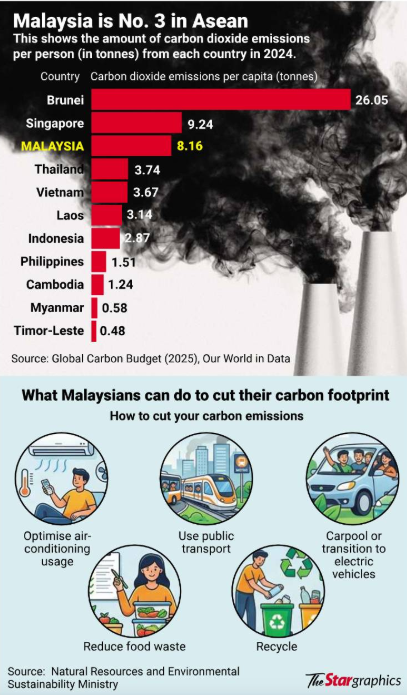
Overall, Malaysia as a country produced a total of 290.22 million tonnes of carbon dioxide in 2024.
Arthur said Malaysia’s relatively high emissions were due to our economy, which includes energy-intensive industries like manufacturing, petrochemicals and electronics that support national growth and competitiveness.
“Electricity generation has relied significantly on fossil fuels.
“Our urban development patterns and relatively high rate of private vehicle ownership have also contributed to emissions growth,” he added.
In Malaysia, the Cabinet had agreed to the Nationally Determined Contribution (NDC 3.0) plan, which involves an unconditional reduction of up to 20 million tonnes of carbon dioxide, with an additional conditional reduction of 10 million tonnes of carbon dioxide.
“Through the NDC 3.0, the government has committed to national greenhouse gas emissions peaking between 2029 and 2034 and achieving an absolute emissions reduction of 15 to 30 million tonnes of carbon dioxide equivalent by 2035.
“This is part of the transition towards net zero greenhouse gas emissions by 2050,” Arthur said.
Net zero, according to the United Nations, means cutting carbon emissions to a small amount that can be absorbed by nature and other removal measures, leaving zero in the atmosphere.
Carbon dioxide is the most abundant greenhouse gas produced by human activities.
To keep emissions under control, Arthur said efforts were focused on improving energy efficiency, accelerating low-carbon technologies and strengthening emissions reporting systems.
He said the rollout of the proposed carbon tax must be carefully balanced against global economic headwinds, domestic inflation and the livelihoods of Malaysians.
“A phased roadmap for carbon pricing is being finalised, ensuring that industries are given adequate notice to adapt without hurting consumer prices.
“Official timelines for the tax mechanism rollout will be announced progressively in national budget tablings,” he said.
Article by By YUEN MEIKENG
Disclaimer
The information provided in this report is of a general nature and has been prepared for information purposes only. It is not intended to constitute research or as advice for any investor. The information in this report is not and should not be construed or considered as an offer, recommendation or solicitation for investments. Investors are advised to make their own independent evaluation of the information contained in this report, consider their own individual investment objectives, financial situation and particular needs and should seek appropriate personalised financial advice from a qualified professional to suit individual circumstances and risk profile. The information contained in this report is prepared from data believed to be correct and reliable at the time of issuance of this report. While every effort is made to ensure the information is up-to-date and correct, Bond and Sukuk Information Platform Sdn Bhd (“the Company”) does not make any guarantee, representation or warranty, express or implied, as to the adequacy, accuracy, completeness, reliability or fairness of any such information contained in this report and accordingly, neither the Company nor any of its affiliates nor its related persons shall not be liable in any manner whatsoever for any consequences (including but not limited to any direct, indirect or consequential losses, loss of profits and damages) of any reliance thereon or usage thereof.
YOU MAY ALSO LIKE

ARTICLE
Oct 07, 2026
|
3 min read
ARTICLE
Oct 01, 2026
|
5 min read
ARTICLE
Sep 29, 2026
|
6 min read
ARTICLE
Sep 29, 2026
|
3 min read