


BIX ARTICLE
Capital market set to help fund semicon’s future growth
Sep 07, 2026
|
9 min read
Featured Posts
Social Bonds Illustrative Use-Of-Proceeds Case Studies Coronavirus
Jul 06, 2020
|
2 min read
Sustainable Banking Network (SBN) Creating Green Bond Markets
Jul 06, 2020
|
2 min read
Why is Inflation Making a Big Comeback After Being Absent for Decades in the U.S.?
Mar 24, 2022
|
7 min read
SC issues Corporate Governance Strategic Priorities 2021-2023
Mar 29, 2022
|
3 min read
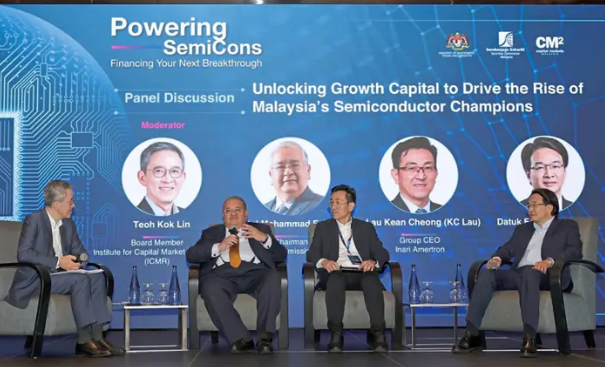
GEORGE TOWN: Malaysia’s semiconductor industry stands at a critical juncture. As global semiconductor supply chains realign, the sector must move up the value chain to remain competitive, and this next leap will require significant capital.
Sustaining this position calls for sustained investment in technology, automation, research and development (R&D) and talent, areas where financing needs often outpace what conventional funding sources can offer.
The electrical and electronics (E&E) industry, anchored by semiconductors, contributes approximately 25% of Malaysia’s GDP and underpins the country’s position as a global manufacturing and assembly hub.
Semiconductor companies and the wider supply chain ecosystem, including small and medium enterprises (SMEs) and mid-tier companies (MTCs), continue to face a financing gap.
To address this, the Securities Commission Malaysia (SC) is working to offer a suite of capital market solutions that can help businesses fund their next stage of growth.
Investment, Trade and Industry Ministry (Miti) deputy secretary-general (industry) Datuk Hanafi Sakri said Malaysia’s semiconductor industry is key to the nation’s industrial transformation agenda under the New Industrial Master Plan (NIMP) 2030 and the National Semiconductor Strategy (NSS).
“The E&E sector, which contributed around one-third of Malaysia’s RM399.3bil manufacturing value in 2025, continues to anchor this growth. Malaysia also has established strong capabilities in semiconductor assembly, testing and packaging, accounting for approximately 13% of the global market.
“As we enter the next phase of growth, access to capital will be essential. Since its launch last year, the NIMP Strategic Co-Investment Fund (CoSIF) has facilitated close to RM92mil in financing to about 42 SMEs and MTCs across all NIMP sectors including E&E, as at end July 2026.
“This reflects the role of catalytic financing in enabling business expansion, technology adoption and industrial transformation,” he said.

“For many semiconductor companies and their supply chain, growth opportunities often require substantial upfront investment in technology, equipment and facilities, well ahead of the revenue these investments will eventually generate. These are needs that traditional, collateral-based financing is not always designed to meet.
“Market-based funding fills this gap. It gives businesses access to equity and growth capital from a broader pool of investors. In turn, this allows companies to pursue expansion, innovation and commercialisation while strengthening their long-term growth prospects.
“The capital market, in this sense, is more than a source of funding. It is a platform for Malaysian companies to scale, innovate and compete more effectively in global markets,” he said.
This push is anchored in the Capital Market Masterplan 2026-2030 (CMP), which targets growing Malaysia’s capital market size to between RM5.8 trillion and RM6.3 trillion by 2030, while advancing economic vibrancy, inclusivity, sustainability and regional opportunities.
SC managing director Datin Paduka Azalina Adham said the capital market offers a funding escalator that supports companies at every stage of growth.
“For semiconductor companies seeking to scale, NIMP CoSIF offers a compelling pathway through its 2:1 co-investment model, where private capital is matched with public funding, helping businesses secure the financing needed to accelerate growth, modernisation and expansion,” she said.
For companies further along the growth curve, Azalina pointed to proposed enhancements to the LEAP Market under CMP, designed to make the pathway to the public market more seamless.
“LEAP Market 2.0 will improve fundraising opportunities and create stronger progression pathways towards an eventual Main Market listing, so that as companies mature, they can access larger pools of capital and support regional expansion, innovation and long-term competitiveness,” she said.
Azalina added that the SC also supports businesses through capacity-building initiatives such as the Elevate Programme, which equips companies with stronger governance practices, enhanced investor readiness, and the capabilities required to scale and access broader sources of capital.
Beyond this, the Simplified ESG Disclosure Guide (SEDG) for SMEs in Supply Chains, provides a simple and standardised way for Malaysian companies to adopt sustainability by providing guidance to disclose ESG.
These financing pathways, and the capacity development support behind them, were showcased at the SC’s inaugural “Powering Semicons: Financing Your Next Breakthrough” roadshow in Penang, which brought together semiconductor companies, supply chain players, investors and funding providers.
The programme highlighted financing solutions across the funding lifecycle, including equity crowdfunding (ECF), peer-to-peer (P2P) financing, venture capital (VC), private equity (PE), public markets and NIMP CoSIF, while also showcasing capacity-building initiatives to help companies become investment-ready.
The first in a planned series of roadshows nationwide, Azalina said Penang was chosen as the first destination due to its position as one of Malaysia’s most established semiconductors hubs and its mature ecosystem of multinational corporations, local champions and supporting industries.
Penang Chief Minister Chow Kon Yeow, who attended the roadshow, welcomed the initiative, noting that financing will be critical to the next phase of growth for Malaysia’s semiconductor ecosystem.
“Our local companies need to be more confident and daring in accessing capital,” he said, citing equity financing, institutional investment and, where suitable, initial public offerings as possible avenues.
Azalina encouraged semiconductor companies and businesses within the wider ecosystem to explore available financing and development programmes early, rather than waiting until capital becomes a constraint.
“The opportunities are already available. Companies should start preparing today so they are ready to secure the funding needed to support their next stage of growth and innovation,” she said.

Investing today for tomorrow’s opportunities
It is time SMEs think outside the box when looking for expansion financing, said Swift Bridge Technologies (M) managing director Datuk SK Chong.
Chong, who runs the technology and manufacturing company specialising in high-performance cable solutions, said the semiconductor industry is undergoing a significant transformation.
“Developing new technologies requires significant investment in R&D, advanced testing equipment, manufacturing capacity and skilled talent.
“For a company like ours, having access to capital is important because the investment required to develop and commercialise new products often precedes the revenue opportunity,” he said.
Swift Bridge managed to raise RM1mil via P2P financing. Its growth journey has also been supported through participation in the SC’s Elevate Programme and funding received under CoSIF.
Chong said the funds allowed them to take a longer-term view, invest ahead of demand and build the capabilities required to capture emerging opportunities.
“The financing has enabled us to invest in new manufacturing capabilities, R&D, infrastructure and technology development.
“Access to capital via P2P enabled us to continue investing in Malaysia rather than focusing on short-term capacity expansion.
“Ultimately, capital market financing helped us invest today for the technologies and opportunities of tomorrow,” he said, adding that they have tripled profits in the past 12 months.
He urged MSMEs and MTCs to view capital market financing as a strategic growth tool rather than just as a source of funding.
“They should think bigger and out of the box, especially since Malaysia has a strong semiconductor ecosystem and a strategic position in the region,” he said.
Turning capital into capability
Malaysian companies cannot climb the value chain on retained earnings alone, said ViTrox Corporation Bhd co-founder and senior executive vice president Steven Siaw.
Sharing how capital market funding built ViTrox, bringing it credibility as much as capital, Siaw said proceeds went into manufacturing floor space expansion, R&D activities, regional sales and support offices, international exhibitions and working capital.
“We were listed on Bursa Malaysia’s ACE Market in 2005, raising RM10.56mil. It was a modest achievement, but transformational for a five-year-old startup.
“Capital market funding gave us the credibility, resources and platform to invest for the long term -- in technology, talent and our global presence.
“Since then, ViTrox has progressed along the funding escalator from the ACE Market to the Main Market, with a market capitalisation of RM17.28bil as at August 2026,” he said.
ViTrox designs and manufactures automated machine vision inspection systems for the semiconductor and electronics industries, exporting to over 39 markets.
“For Malaysian technology companies with global ambitions, access to funding via the capital market can be a powerful catalyst to scale, innovate and compete confidently on the world stage,” Siaw said.
Article By N. TRISHA
Disclaimer
YOU MAY ALSO LIKE

ARTICLE
Oct 19, 2026
|
6 min read
ARTICLE
Oct 18, 2026
|
5 min read
ARTICLE
Oct 16, 2026
|
5 min read
ARTICLE
Oct 09, 2026
|
4 min read