


BIX ARTICLE
World’s first tightening cycle in the works
Feb 05, 2026
|
5 min read
Featured Posts
Social Bonds Illustrative Use-Of-Proceeds Case Studies Coronavirus
Jul 06, 2020
|
2 min read
Sustainable Banking Network (SBN) Creating Green Bond Markets
Jul 06, 2020
|
2 min read
Why is Inflation Making a Big Comeback After Being Absent for Decades in the U.S.?
Mar 24, 2022
|
7 min read
SC issues Corporate Governance Strategic Priorities 2021-2023
Mar 29, 2022
|
3 min read
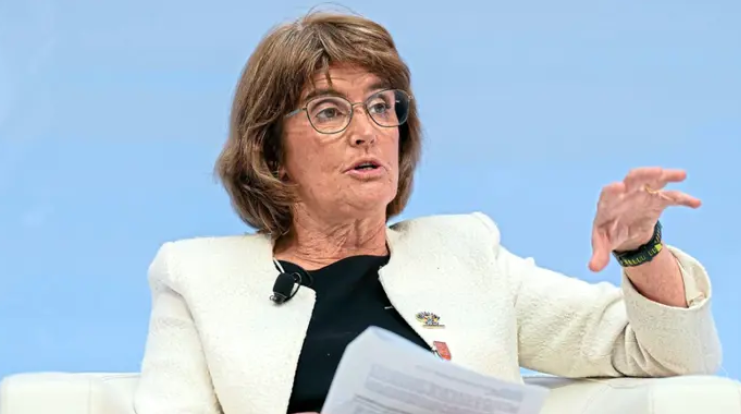
Rising trend: Bullock is tough on inflation, saying if the RBA didn’t raise the interest rate it would have signalled a tolerance for inflation being above target. — AP
|
Two of Australia’s big four banks as well as Goldman Sachs Group Inc switched their calls since the Reserve Bank of Australia (RBA) on Tuesday became the first major monetary authority in the world to raise rates this year.
They now see another hike in May to take the cash rate to 4.1% after policy makers boosted borrowing costs by 25 basis points to 3.85%.
A second rate increase would mostly unwind the RBA’s easing effort last year: one of the world’s shortest and shallowest cutting cycles of just 75 basis points over six months.
It would also contrast with most global peers such as the Federal Reserve, who are mainly seen either reducing interest rates or holding them steady.
The decision by Commonwealth Bank of Australia, Westpac Banking Corp and Goldman to focus on May reflected the timing of the meeting, which came shortly after the quarterly inflation release and coincided with the RBA board receiving updated staff forecasts.
National Australia Bank’s Sally Auld had already forecast two rate hikes this year and is sticking with her view.
ANZ Bank is alone among the big four lenders in expecting a prolonged pause from here.
“While the governor did not provide any forward guidance, the combination of language used in the press conference in conjunction with the revised set of forecasts, suggest the RBA has initiated a hiking cycle – rather than a single ‘fine-tuning’ hike,” Goldman’s Andrew Boak said.
Boak, who had earlier expected the RBA would stand pat this week, pointed to its latest macroeconomic forecasts released alongside Tuesday’s rate decision for his change of view.
Those estimates are based on the technical assumption of a further 35 basis points of rate increases by year’s end, implying that “no further tightening would result in a longer delay to the 2.5% target,” he said, referring to the mid-point of the inflation band.
During her post-meeting press conference, governor Michele Bullock talked tough on inflation, saying, “if we didn’t raise the interest rate today it would have signalled a tolerance for inflation being above target, and that’s not the message we wanted to send.”
Yet she was at pains to avoid giving any indication that further tightening is in the offing.
The RBA’s higher forecast for inflation this year came as it also anticipated economic growth would slow to 1.8% by the end of 2026 and cool further thereafter.
That combination underscored the structural pressures in the economy, including weakening productivity that is constraining supply capacity and complicating the inflation outlook.
“Given the remarkably blunt comments about capacity constraints, rising inflation, rising labour costs, declining productivity and global trading partners we doubt that the board believes that one single 25-basis-point rate increase is going to be enough,” said Sean Keane, chief strategist for Asia- Pacific at JB Drax Honore.
He said a hike at the RBA’s March 16-17 meeting “may not be too soon,” suggesting there would be a strong focus on the next monthly consumer price index report due on Feb 25.
That said, money markets are currently pricing just a 16% chance of a March hike whereas a May tightening is currently at 85%.
Still, some traders took Bullock’s press conference remarks as dovish after she said there was no discussion of a 50-basis-point increase at the RBA’s two-day meeting.
She also stressed that the board would move cautiously and respond to incoming data, echoing its approach during last year’s easing cycle.
“We think that interpretation is the wrong one,” Keane said, “and the market is not thinking about the role of the governor and what she can and cannot say under the recently revised RBA board structure.”
The RBA shifted to a new model last year under which its nine-member board votes on policy decisions, rather than arriving at a consensus as it did previously.
Policy statements are now issued in the board’s name, rather than the governor’s, limiting the RBA chief’s scope for explicit forward guidance at press conferences.
The return to rate hikes “reflects the challenges of delivering and then sustaining a soft landing in a low-productivity-growth economy,” NAB’s Auld said.
“It also serves as a reminder that inflation in the post-Covid world is likely to be more volatile and less predictable.” —Bloomberg
Source: World’s first tightening cycle in the works (Thursday, 05 Feb 2026). The Star. Retrieved from https://www.thestar.com.my/business/business-news/2026/02/05/worlds-first-tightening-cycle-in-the-works
The information provided in this report is of a general nature and has been prepared for information purposes only. It is not intended to constitute research or as advice for any investor. The information in this report is not and should not be construed or considered as an offer, recommendation or solicitation for investments. Investors are advised to make their own independent evaluation of the information contained in this report, consider their own individual investment objectives, financial situation and particular needs and should seek appropriate personalised financial advice from a qualified professional to suit individual circumstances and risk profile. The information contained in this report is prepared from data believed to be correct and reliable at the time of issuance of this report. While every effort is made to ensure the information is up-to-date and correct, Bond and Sukuk Information Platform Sdn Bhd (“the Company”) does not make any guarantee, representation or warranty, express or implied, as to the adequacy, accuracy, completeness, reliability or fairness of any such information contained in this report and accordingly, neither the Company nor any of its affiliates nor its related persons shall not be liable in any manner whatsoever for any consequences (including but not limited to any direct, indirect or consequential losses, loss of profits and damages) of any reliance thereon or usage thereof.
YOU MAY ALSO LIKE

ARTICLE
Mar 12, 2026
|
5 min read
ARTICLE
Mar 10, 2026
|
5 min read
ARTICLE
Mar 09, 2026
|
4 min read
ARTICLE
Mar 05, 2026
|
4 min read